A while ago, “What’s Wrong With the Net Promoter Score” by Augustine Fou was posted on ClickZ. Sure, Net Promoter Score has it’s critics but I flagged it for detailed review and response because it contained a large number errors and mis-statements that I wanted to comment upon.
As it happens, when I went back to review the article, I found lots of other people felt the same, judging by the volume of comments attached to the article.
Before I go further, I should say that I’m not a blind supporter of NPS®. I only support it because it has been shown empirically to work. I support it for the same reason that I use the telephone: I don’t know exactly how it works but it does, and I’ll continue to use it until it stops working or something better comes along.
There are so many mis-statements in Fou’s article that I could go through it line by line. But that would be a little tedious so I’ll break it down into the same three summary points provided by Fou:
“NPS doesn’t tell me anything new” – This is Patently False.
Perhaps the key feature of NPS is that for the first time it tells us the most important thing: whether a customer is feeling loyal and how loyal all of our customers feel. For the last 50 years companies have been trying to get a handle on exactly this question. We’ve spent countless hours and millions (perhaps billions) of surveys to capture this one piece of information. For years we tried measuring “customer satisfaction” but that has been shown to be poorly related (and poorly correlated) to customer loyalty.
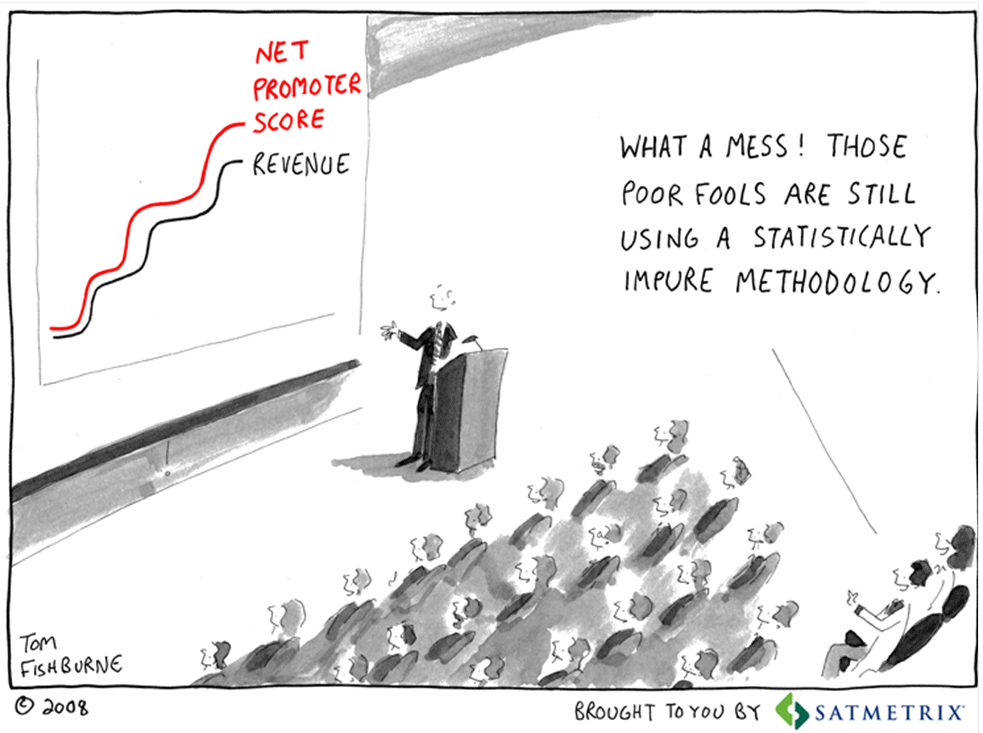
It also tells us this, in a simple to understand, practical, predictive way. If we increase NPS then our revenue will probably rise, if NPS goes down then revenue will probably drop. This cannot be said for any other single measure that I am aware of.
Lastly, all products lend themselves to word of mouth, but the percentage of the population interested varies dramatically by category. NPS does not stand alone for all markets, true, but customers NEVER judge you in isolation, they always see you and your brand in the context of others. In fact the best comparison is to your own last NPS score, which brings us to the next point.
“NPS is based on flawed math”. This is Empirically False.
Fou states that NPS is based on a “seemingly arbitrary 11 point scale”. At which point I would suggest that all scales are arbitrary (except binary?). NPS is no more arbitrary than 1-10, 1-7, etc used for other surveys.
However, reliability and validity are the only criteria that are relevant in this discussion. It is not the scale that is used but the fact that it works that is important. The analysis behind the survey indicates that this scale, regardless of it’s theoretical underpinning, works and that’s enough for me.
The article also points to NPS being attitudinal rather than behavioural, i.e. “How many times did you recommend company X”. For my part I have always consider that it’s not actually about whether you HAVE recommended a company, it is asking WOULD you lend your personal credibility to this company. So it really has little to do with the actual event of recommending a company as it has everything to do with how you feel about recommending a company.
“Not actionable” – This is Only True if You Let it Be.
Sure if all you ever did was run an NPS survey, take the number and report it, you do not have an actionable approach. Incidentally, this is what occurs in a very great number of customer satisfaction surveys, “likeliness to buy” scores and countless other approaches. The company gets the report and looks around at each other asking: “So what now” or “So does anybody know why it went up?”
Nobody should be naively using NPS without collecting additional information to allow a root cause analysis of what is different between promoters and detractors. In fact, if your customer segmentation does not systematically explain the difference between promoters and detractors it is probably not very useful for marketing and definitely not for CEM.
Using NPS as the key metric of loyalty, you can create closed-loop processes so that the right employee directly investigates the root causes that drive customer response to the NPS question. Then you are acting directly on the drivers of customer loyalty.
NPS is a cross departmental strategy to focus the organisation on how it is treating and impressing customers, not a standalone ‘what is the meaning of the universe’ answer. This is a business indicator that has the customer in the centre and takes us back to Deming and his approach to building strong customer focused businesses.
At its heart this is why NPS is so useful: because it provides us with a clear proxy for customer loyalty that we can act on in a purposeful and methodically manner.
Finally, Fou’s article closes with a suggestion that a better approach than NPS is to use changes in search volume to gauge success. Suggesting that search volume is a good indicator of customer loyalty seems a little light-weight. This approach appears to be more of a way to fine tune the sales and marketing information process than understand the drivers of customer loyalty.